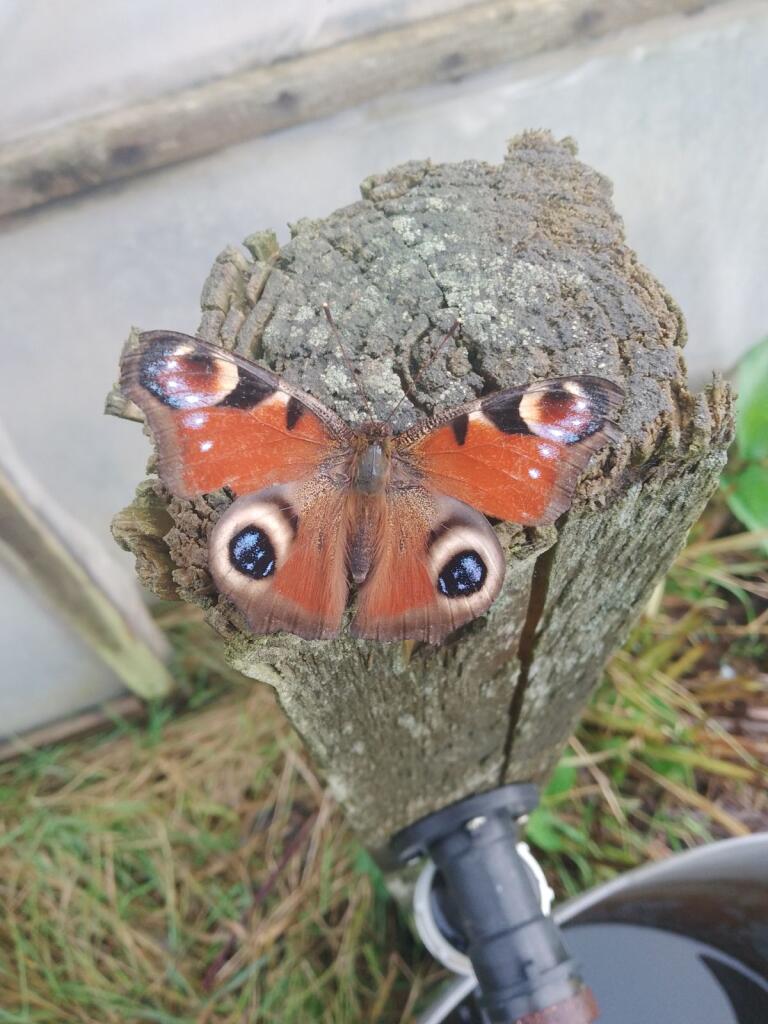
This peacock butterfly was photographed by Ian, one of our growers, on the fields back in the autumn. Along with the exclamation, “This year!”
So, what do we know, or can we learn, about peacock butterflies?
They are insects and in fact there are two sub-species – a European one and an Asian one. They hibernate in winter amd come out again in the spring. As a butterfly their diet is nectar, sap and rotting fruit. The caterpillar stage like nettles (someone has to like nettles!) The caterpillars are mostly black with small white spots and lots of spiky hairy parts. Small groups of caterpillars collaborate to spin a communal web around the leaf where they hatched from eggs. After being caterpillars they form a chrysalis until they are ready to emerge as a butterfly. Male butterflies have one elongated body segment whereas the females have five very hairy ones. We think we’d need a closer look than this butterfly photo to really know. The underside of the wings really looks like a leaf and is also a wonder of nature.
Their biological name is Aglais Io – the Io part comes from a Greek myth. Space fans will also know Io as one of Jupiter’s moons! Now there is a good pub quiz fact for us all to tuck away and remember!
Here (https://www.mdpi.com/2075-4450/12/8/683) we can read in a scientific paper that citizen science records in Belgium have proved that these butterflies are now having more than one generation a year. This is why Ian was surprised to see one in the autumn! As he would be expecting them to start hibernating at the end of summer. But no, records from the public show that there are now three peaks every year to seeing the adults. The first peak is in the spring, when the overwintering adults are out. The second peak in the summer, when the first caterpillars emerge from their chrysalises. And now this third, autumn peak. The scientists were using pictures from members of the public submitted online, and looking in particular at how worn the butterflies’ wings were.
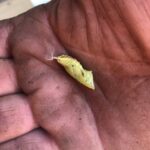
All this talk of the chrysalis stage reminded us of another post back in July where Ian found a chrysalis hanging. Revisit it here! https://golocalfood.org.uk/ian-loves-photographing-insects/. In this post we emailed Butterfly Conservation to help with identifying the chrysalis and they were able to tell from the photos that it was a peacock butterfly. It is not impossible that, if Ian was able to hang the chrysalis back up (you can use a bit of tooth floss if you ever find one), that the adult butterfly shown in the photo is related to the individual inside the chrysalis.
Is this third generation another sign of climate change perhaps? This third peak of sightings in the calendar year can happen in particular when the second generation is less abundant. Nature is trying to make sure that the population has a stronger start ready for the next year. It is clear that seeing this extra generation was rare about four decades ago, but has now become more and more likely. In Belgium it has become the rule since 2005. So, although maybe Ian was surprised to see one in October 2023, it will become the norm here, as it has done in Belgium.
Let’s hope that, at this time of year, the end of December, this particular individual found a nice dark place in a shed or a tree trunk crevice, with the underside of their wings keeping them well hidden. And we can look forward to March 2024, when they might emerge. Roll on the spring!