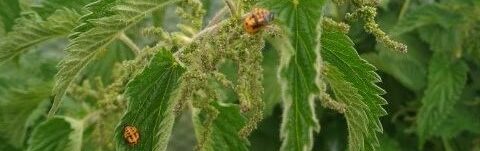
It is time to get up close and personal with a few pollinators! When we say pollinators, you might think of honey bees. There are actually more than 250 species of bee in the UK, the honey bee is only one – then there are about 24 bumblebees, and all the rest are bees like solitary bees or mining bees!
Those of us who remember David Bellamy on TV will remember his enthusiasm for all things small and wildlifey, so time to channel your inner Bellamy and look what you can find at this fertile time of year!
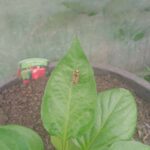
Ian has been busy taking a few photos of insects he has found on the fields. This first one is a hoverfly on a pepper – we think taken through the poly tunnel. There are more than 6,000 species of fly in Britain, and about 250 or more of them are hoverflies. The biggest one is about 2cm long so we can rule that one out! They lead short lives but do a lot to protect crops and ecosystems. They are sometimes called “farmer’s friends”. They are the second most important pollinator after wild bees. Some of their larvae have an appetite for aphids that otherwise suck the sap out of crops. They love to mimic bees and wasps – some even pretend to sting if provoked, or lay their eggs in a bee nest. The way they look helps to stop them being eaten by predators.
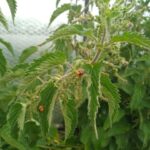
Here is another photo from Ian, this one looks like a ladybird – although it is very orange, isn’t it. There is an orange coloured shieldbug but that is only found along the south coast. What it is actually is a ladybird pupa, the harlequin ladybird pupa. The harlequin ladybird became established in the UK in 2004 and is now widespread. It originates from Japan and was introduced around the world to control aphids. It wasn’t actually introduced to the UK but came here anyway. Sightings of ladybirds can be sent to the ladybird survey www.coleoptera.org.uk/coccinellidae/home. Is the harlequin ladybird a problem? Evidence in Britain so far is mixed. There was a fear it would out-compete some of our native aphid predators. Or that it would feed on other insects like the larvae of butterflies and moths. Research is ongoing.
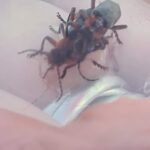
Here are two soldier beetles loving each other in a special way! 🙂 This photo was taken in early May at the Spetchells in Prudhoe, on a guided walk led by the Natural History Society of Northumbria. There is a lot to say about the Spetchells site and why it is special so maybe that will be another web post. Soldier beetles are one of our most common. Here is a lockdown blog about spring on the Spetchells www.nhsn.org.uk/spring-on-the-spetchells/. There are about 40 species of soldier beetle in the UK. The larvae eat worms, snails and other invertebrates – hiding under leaf litter or rocks throughout the winter.
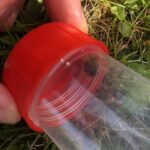
A shieldbug! This one was carefully caught in a little tube just to help look at it and photograph it, and then released again. Can you see its body is shaped like a shield? We think this is the Hairy Shieldbug. It is pinky – purpley – brown with a green shield. Its abdomen has chequered black and white edges. The antennae are also banded black and white. Its nymphs are covered in lots of fine hairs, which is where it gets its name, but it is also called the sloe bug. It is common across England and Wales, found in hedgerows or parks and woodland edges. Here is a guide from the Woodland Trust to 10 common shieldbugs https://www.woodlandtrust.org.uk/blog/2021/05/shieldbug-identification/.
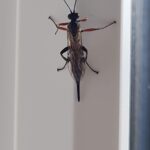
This insect was seen not at the fields but at home, on the window edge. It is a Darwin wasp, we think. In the UK we have about 2,500 known species of darwin wasp – making up almost 10% of British insects. They are largely overlooked and unknown! You might often see them on plants like cow parsley. Considering their abundance, it would not be surprising if they turn out to be important pollinators in many habitats. We do know however than most of them are parasites on other insects – this means they lay their eggs on a host, which the larvae feed on and eventually kill. Actually, we should say “parasitoid” in this case. The word “parasite” means to live off a host but not usually kill them. The apparent cruelty of these insects troubled Charles Darwin, who wrote about them in a letter in 1860 – and this famous quote is why a group of specialists suggested the name “Darwin wasps” for the whole group, so they become more widely known and studied.
“I cannot persuade myself that a beneficent and omnipotent God would have designedly created the Ichneumonidae with the express intention of their feeding within the living bodies of Caterpillars”
Charles Darwin, in a letter to American naturalist, Asa Gray