Here is a bit of information and research about helping our lovely growers, Ian and Jala, find alternatives to the small amount of peat we use in growing seeds. (January 2023).
What is important for the growers is the reliability of germination and the sterile, light nature of a growing media and its consistency.
Current situation
Eliza from Newcastle University visited us last year and had a tour around the fields with Ian. He explained how a small amount of peat coming from the nursery Halls of Heddon goes into our compost bays, mostly in the form of old potted plants. It is kept in dumpy bags for about 6 months until it is ready to go onto the pumpkin patch.
Our seeds are sown in fresh growing media, there is too much risk otherwise of diseases or mould affecting them. Other growing schemes probably buy in plug plants, so the problem about peat as a growing media is one step away from them, but as we grow from seeds we know we use 60-odd or just over 70 bags of John Innes enriched peat compost which is bought from Halls of Heddon and comes from the supplier “Clover”. This costs about £337.

We don’t know if these are 70L or 75L or 80L size bags, but assuming 80L this makes 5,690 litres of growing media in a year, or just over 5.5 cubic metres. The bags from Clover probably don’t say what % of the mix is peat.
Since our members’ meeting in October, Ian has been experimenting with some green waste composting in one of the bays to see if he can make a fine enough mix (grass cuttings + brassicas + soft greens + meadow hay + some 1 year old wood chip). Ian and Jala are happy to try some experiments, but not lots of alternative media at once! More like a different variety every fortnight.
What do other projects do?
A few members had some contacts to follow up on, to find out how they are planning or experimenting with going peat free.

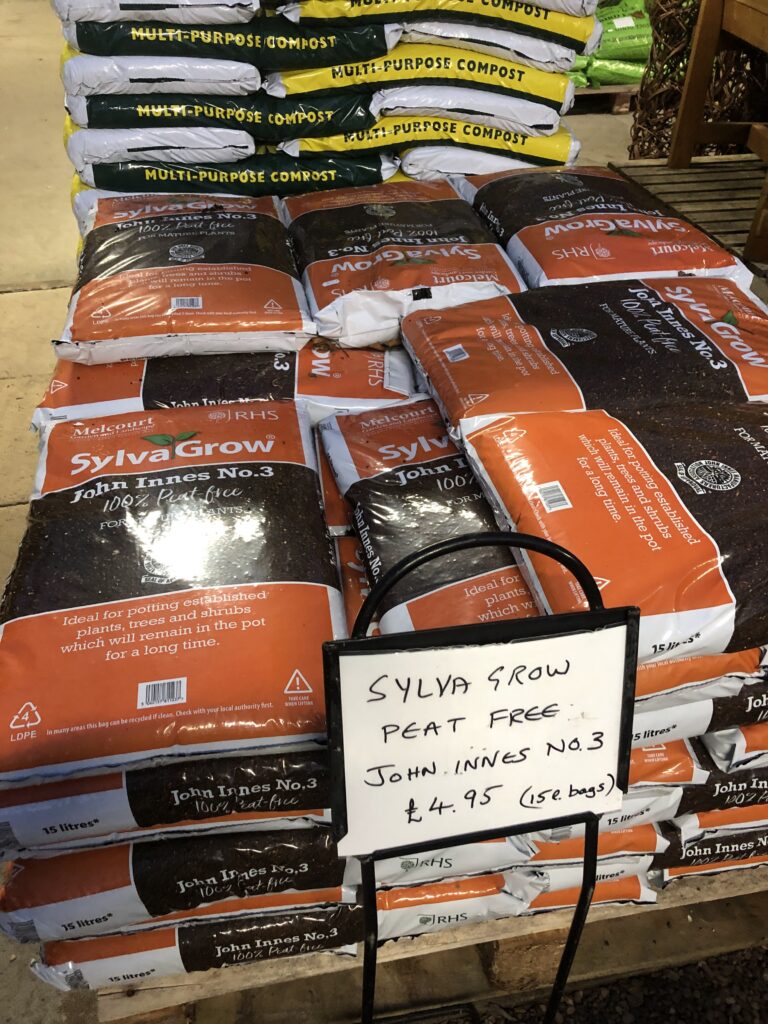
Perennial Favourites is a nursery in Blyth that went peat free recently (https://www.facebook.com/perennialfavourites). They use Sylvagrow from Melcourt and report it has a good structure although it is a bit more expensive. Adam wrote back to us, advising that it does behave slightly differently to peat based composts, especially around the density when seed sowing. He found in 2022 his batch was very ‘hungry’ and begonias didn’t like it, but most of the seed sowing has been fine. He tends to cover it with vermiculite (more about this later) to keep the surface moist, or adding perlite to plants needing good drainage. So far, Adam hasn’t found an alternative that behaves exactly like peat. He also mentioned a Levington’s product (which may be based on sheep fleece) which he found lumpy and found it difficult to create an even surface for seed sowing. There is still a lot of experimentation to do by the horticultural industry.
Vertical Veg North East – Mark kindly replied to our email saying he uses Aldi’s “Gardenline” product, growing on just a small scale at home. He has also finds Sylvagrow to be one of the best (this is made from composted wood fibre and has fertiliser added in). It would be cheaper to buy in the pallet. He advises that you do occasionally get a batch which isn’t so good, as with nearly all composts. Mark also mentions coir, one of the best suppliers being Fertile Fibre. Coir is a material coming from the coconut industry but it does need water and some labour to make it, and it is shipped a long way (more about coir later). It needs some sort of fertiliser added to it. For making our own compost he recommends the work of Ben Raskin of the Soil Association who has been working with farmers to create a wood chip high quality seed product.
There are some reviews here, including coir, wool and biochar https://www.gardenersworld.com/product-guides/growing/best-peat-free-composts/
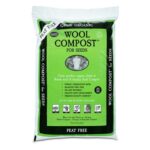
One of our members asked us to research Dalefoot composts (https://www.dalefootcomposts.co.uk/our-products.aspx) – having had good results with larger plants, but not seed compost yet. The products are made from bracken and wool in the Lake District by Barker and Bland, who also carry out moorland restoration. Our grower Jala tried Dalefoot at her previous site, but it was during a generally bad season for germination all around. So, hard to tell whether it was a bad year or something to do with this growing media. It might be a good idea to mix this with our existing supply until seed success can be assessed.
Another member asked us to contact Andy Dibben at Abbey Home Farm in Cirencester who is a member of the Organic Growers Alliance (OGA). Andy has been doing a lot of experiments, and it turns out Jala has been there too (and raved about it!) They are experimenting with wood chip compost for propagation (the wood chip comes from a local tree surgeon) but it takes 2 years to rot down. For general purpose, for beds, they use the wood chip compost mixed with veg waste – applied to the surface of the soil only, never worked in. And, when they run low, they use Klassman’s peat free compost, but this has quite a high nitrogen content (and that is not great for seeds).
https://www.pumpkinbeth.com/2021/08/2021-compost-trial-growing-broad-beans/ “Pumpkin Beth” does a peat free trial every year, spending a weekend driving round buying as many different bags as possible! In 2021 she did broad beans, here are the results (you can jump forward to the conclusions using the liks on her website).
https://www.jackwallington.com/peat-free-compost-trials-2021 Jack Wallington did some really detailed experiments in 2021, here you can read and see all his results. See how that some seeds start off behind, but quickly catch up.

Cheviot Trees – a tree nursery near Berwick upon Tweed. They grow broadleaf trees in a peat free mix that includes small granules of slow release fertiliser. The supply company is called ICL and is based in Ipswich. Their media is delivered in huge bales e.g. 2m high and a pallet wide. These are loaded into a special machine which lifts them up high that then breaks the bale down for use on a planting production line.

The week after our members’ meeting in early February 2023, Farming Today on BBC Radio 4 dedicated to various peat issues. Here you can listen again to the episode from 7th Feb 2023. “Commercial growers are still allowed to use it for now, but from next year, domestic gardeners won’t be able to buy it. Retail sales are being banned to help the government reach its net zero targets, as peatlands are the UK’s largest carbon store. Organic growers would like to be ahead of any mandatory targets but for commercial nurseries that rely on machines to plant blocks of plants, it’s going to be a challenge.“ https://www.bbc.co.uk/programmes/m001hx1w
Finally, we also spoke to Halls of Heddon in Heddon! The problem for the horticultural industry, they said, is that customers expect to buy ready made impact plants. A generation ago gardeners would have bought lots more, or all, bare rooted stock (especially their speciality, dahlias). Customers of today expect pot plants, in plastic pots, maybe we also need to help customers change their expectations.
Webinar
We also watched this webinar, from February 2022, and took notes. Worth a watch though!
History of peat in UK horticulture The first speaker, Judith Conroy spoke about this issue. The use of peat was not widespread in Victorian Gardens but slowly got introduced after the development of John Innes potting mixes from the 1930s onwards. There is lots more detail in the webinar, but the important date to note is that by 2024 amateur gardeners will no longer be able to buy peat products. The cut off date for horticulture and market gardeners hasn’t yet been announced although certified organic producers, say the Soil Association, will have to phase out by 2025.
The second speaker is “Tolly from Tolhurst Organic”. He started trials in 1987 including using cocoa waste, leaf mould, steam-sterilising soil to mimic the John Innes mixes – but the problem was always the lack of consistency, poor results, and hard to produce.
“You will never find anything as good
Tolly
as peat for holding water”
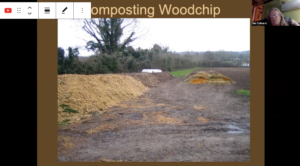
Wood chip from a local tree surgeon is rotted down for about 18 months is large winrows and turned 3-4 times during this period. The pictures make it look like quite a large scale operation but smaller scale could be done in dumpy bags without turning. The temperature gets up to 75C – 83C. Tolly explains his recipe which is mixed up in buckets, and also involves a grader, rotary sieve and is all mixed in a cement mixer. He adds vermiculite to his recipe, which is imported from Portugal (vermiculite is a sort of mineral extracted from the ground and expanded under heat / pressure to make something a bit like pumice, which helps with water retention and to slow-release the nutrients in a media). His tip is to make sure the wood chip is fairly dry. For alliums he also adds fertiliser. He believes the media works well because it is fungal rich. He has costed his time and the additional materials, with a final cost of about £130 per cubic metre or £13 for 100 litres which is about the same as buying in. He stresses the importance of good raw material – not too much leylandii (no more than a third) for example. For seed sowing the 18-month material is left a further 6 months. Some bits of wood chip will never rot, which is why he needs a regrader as part of his mixing. He does say however he has never had a crop fail in propagation, sometimes there has been dampening off, particularly with beetroot, but this could have been linked to sowing too early, the weather too cold or too damp. Some comparisons have been done with Klassman (there followed quite a technical discussion about nitrate, soluble nitrate and ammonia, then potassium).
(as an aside here is another Q&A about Tolly’s mixture https://innovativefarmers.org/sharing-knowledge-from-the-field-labs/horticulture/propagation-substrates-is-woodchip-a-viable-alternative-to-peat-qa-with-iain-tolhurst/).
The third speaker is Frances Rayns from the Organic Plus project. A set of scientific comparisons have been done with lettuces and leeks in composted wood chip mixed with vermiculite at either 10%, 20% or 30% and compared with Sylvamix as a control. The lettuces didn’t do well in the Sylvamix but all the wood chip mixes did well which was explained by that medium having a higher electrical conductivity (potassium ions?). The wood chip compost had more available nitrogen. (quite a lot more technical stuff in this part of the webinar if you are into that sort of thing!)
The last speaker is Margi Lennartsson who was talking about the Responsible Sourcing Scheme.

This is a rigorous way of scoring growing media by 7 criteria. It is a useful calculator for comparing different media, to make sure that any alternatives we wish to try aren’t damaging in a different way. The rigour comes from the fact it isn’t just estimated, but has to be evidenced. The symbol looks like a set of 5 coloured leaves with an arrow pointing at the final score. A is “good” and E is “bad” and relates to a score out of 20 where 20 is good and 0 is bad. Peat products end up with a score between 0 and 4, as does vermiculite. Most products have been scored by manufacturers and independently verified (although smaller, local producers may not be able to go through this certification).
https://www.responsiblesourcing.org.uk/

The 7 criteria are:
- energy (including transport) and accounting for the type of energy
- water use
- social compliance and worker conditions (very hard to evidence)
- habitat and biodiversity
- pollution
- renewability (5 years, 50 years, 1000 years)
- resource use efficiency (e.g., waste generated and efforts to minimise)
Margi tried to score Tolly’s mix and it is probably about 17-20 until the vermiculite is added. Most additions of minerals will mean a mixture scores very badly but this element would have to be scored by vermiculite producers.
Coming back to the issues of coir and fertilisers noted above, it is important to know that they are accounted for in this scheme, and that they could be part of our decision making.
Note that one of the alternatives is called Moorland Gold which is peat reclaimed from reservoirs – do we think this is a ‘green’ product, or is ‘greenwashing’? Other companies may have a high-scoring peat free product, but if they are still selling peat clearly harvested from peat bogs, are we happy to spend our money on this company? (this gets us into the realms of a procurement policy!)
Costs
So, what alternatives are good and how much might they cost? It partly depends if we have to buy an organic mix or not, as yes, they all tend to be more expensive. Or which ones our growers think would be good for seeds rather than all purpose mix.
As a reminder, we think about 5,500 litres and we are currently spending £337. (although the prices that we can find from googling are not the best prices we could get by buying a pallet or by buying through Halls of Heddon).
The ‘next cheapest’ is a Levington peat free multi purpose with John Innes which comes in 50L bags and which will cost an extra ~£345 a year.
The second best after that is Sylva Grow multipurpse (Sylva Grow do a number of products which scores B on the new rating system and will cost us an extra ~£447 a year.
The third best is Westlund New Horizon peat free which will cost us an extra ~£421 a year.
Klassman’s comes out fourth, it is organic but probably not for seeds, it will cost us an extra ~£493 a year.
Fifth is Champions Blend peat free by Bathgate which, yes, it is organic but hard for us to find out if it is good for seeds or not, it will cost an extra ~£537 a year.
The first one in the list that specifically looks good for seeds is Sylva Grow with added John Innes seed compost, which scores C according to the responsible sourcing scheme (this may be because it has added fertiliser). It would cost us an additional ~£801 a year.
Next steps?
It would be fantastic if Ian and Jala could pick some of the alternatives they would like to experiment with, alongside their new ‘green compost’. If we know what they would like and in what quantities we can perhaps see about getting it cheaper in a pallet. Could they report back at the next members’ meeting?