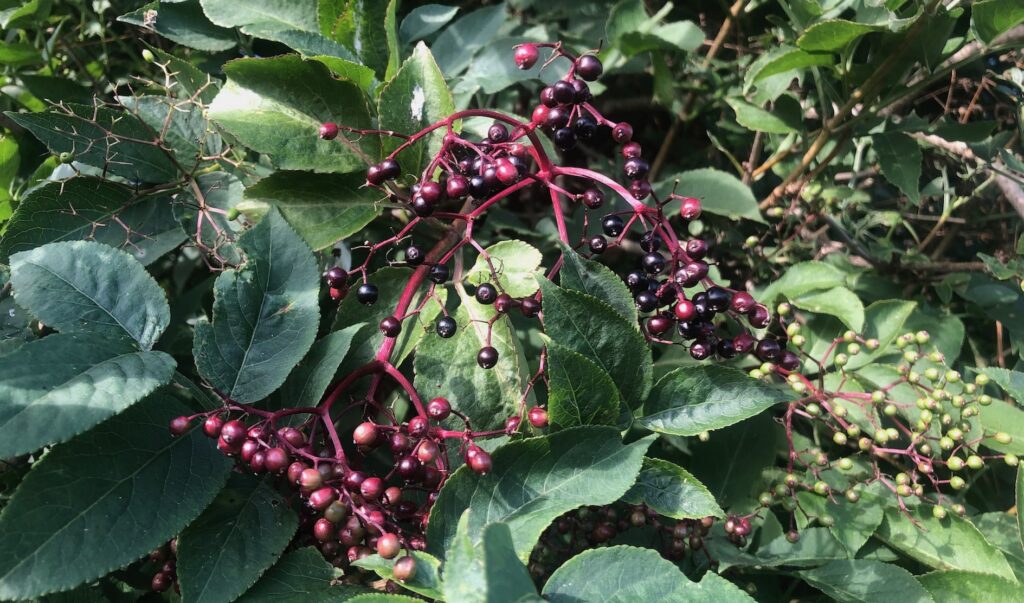
How can it be nearly the end of summer already! And yes, already into meteorological autumn! At this time of year there are so many interesting things to spot! Here are a few to look out for over the next few weeks. How many do you notice, or what are your favourite signs, to look ahead to the new season.
Berries. There are lots of them about and the start of September seems the best time for blackberries! Or brambles as you might call them. The berry at the end of each cluster ripens first and is the sweetest. Easy to recognise, anybody can get involved with brambling and maybe making a pie, crumble or jam afterwards. Beware the hazard of being prickled! That is, if you get any home without sustaining yourself on a walk by eating as you go along!
Mammals, birds and insects may also be eating some of nature’s bounty and you may notice spider webs in amongst the bushes, especially if it is a dewy morning.
It is really autumnal and fairly easy to get a good photo of, even in gardens, without having to go too far! We’d like to see anybody else’s photos of glistening spider webs – even better if there are some autumn berries on the bush in the background! It gives the little flies that might otherwise be the spider’s breakfast some warning that the web is there – perhaps spider weather forecasters tell of “hungry gap” when the mist is rolling in!
Here is a poem called “Blackberry-Picking” that Seamus Heaney wrote about blackberry picking in late August as a child. “Each year I hoped they’d keep, knew they would not.” Gather blackberries before Michaelmas (29th September), or, as the saying has it, the devil has spoiled them. Or, one of my annual favourites, “To Autumn” by John Keats. “Conspiring with [the sun] how to load and bless / With fruit the vines that round the thatch-eves run“. Do you have a favourite autumn poem?
Bramble patches are great places to study spiders in early autumn. You may be lucky enough to see a web being spun. But you also might notice spiders indoors. Don’t be scared! I heard a comedian say, “Everyone’s a feminist until there is a spider around”!
Harvestmen look like spiders and also have eight legs. The legs are often very long compared to their small, round bodies. The difference is that the fore and the hind parts of the body are fused into one unit. Some have a ‘turret’ raised up for the eyes. You might be able to find several different species in a garden, or nearby hedgerow, or woodland, or at the fields!
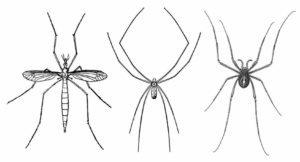
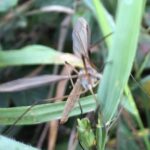
You might also notice about daddy longlegs. They are sometimes called harvestmen, sometimes called crane flies but the names are often confused with two other insects. The cranefly daddy longlegs are not spiders and they don’t make webs. They actually can’t see very well but they have sensitive legs. As a larva, it is a brown grub that lives in grassland, eating plant stems and roots, also known as a ‘leather jacket’, and a good source of food for birds who can peck into grassland soils. So, they are an important part of the food chain. At this time of year they will be concentrating on mating and laying eggs in the grass. They only live for about two weeks as an adult. Can you get us a good photo of a daddy long legs in your garden or on a walk?
Just to try to clear up any confusion:
- We are talking here about the daddy long legs cranefly – which has two wings,
- There is a daddy long legs spider Pholcus phalangioides, sometimes also called cellar spider, is als often found indoors,
- Harvestmen – which can also have very long legs, but have a more rounded body made up of just one section. The Field Studies Council have just produced a guide to ID the common harvestmen with photos of all the species in Britain and Ireland.
If all else fails and you haven’t spotted any signs of autumn or felt autumnal yet, try eating some orange soup and wearing jumpers even if you don’t feel cold! Look out the window at dusk and comment about the nights drawing in, then muse aloud about the clocks changing! Tut about halloween or Christmas things for sale in the shops! Plus of course, in the Tyne Valley, we have our lovely river mists to look over in the mornings.