
Did you know that there are about 250 different species of dandelion? Neither did we! They are instantly recognisable, aren’t they. With their yellow flowers and their “clocks”. But actually there are small differences between them, which you may notice after reading this!

Recently we went to a conference of the Botanical Society of the British Isles (BSBI), held in Newcastle. One of the world experts in dandelions, John Richards, works at the University, and he was giving a dinner time talk.
Why so many species? Well, us humans have 23 pairs of chromosomes. Whereas dandelions evolved to have three sets of chromosomes, 16 + 8. Actually, bananas are similar – perhaps you had heard this about bananas before – almost all our edible bananas come from 2 species. This strange number of chromosomes gives the plants a problem. How to reproduce!
Dandelions do (as any child knows) do make their clock, their seeds, but they can’t really breed with each other. The seeds are almost clones of their mother. This makes them a “microspecies”. And from these dead-ends of genetic diversity, comes a lot of differences to notice between plants!
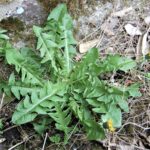
You might first notice how the teeth on the leaf can vary – how jagged are the teeth, how round are the tips of each teeth and the end of the leaf? How much space on the leaf stalk is there between the teeth?
(While we are on the topic of the leaves, you can cook them and eat them. Just like you would other greens or salad leaves. They are regularly used in Asian cooking. Full of vitamins and minerals!
Here is a recipe https://www.bhg.com/can-you-eat-dandelions-7568696.
Here are some more recipes https://www.eatweeds.co.uk/dandelion-taraxacum-officinale as we know many of our readers love recipes!)

You might notice that under the flower head some of the “petals” (technically “ligules”) have a coloured stripe, whereas other flowers on a different plant don’t. At the time of writing, it is the time of year when we are just delighted to see snowdrops again, but it can’t be long until spring. Then we can all start rushing outside and taking a look and the variety around us!
You can actually also make a honey from the ligules, the petals. It must take some time to collect quite a few – you need a “cup full” (the recipe we have found is American) and you have to take time separating the yellow ligules from the bitter green parts, the bracts. (Also take time to look at the bracts – they vary in how wide they are and how much they point and curl downwards to clasp the flower stem).
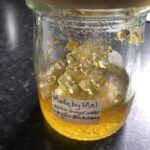
Here is one suggested recipe https://adamantkitchen.com/dandelion-honey/. You will need petals, sugar, water, and lemon juice. Simply simmer the yellow petals with water and sugar, until it thickens. To collect about 1 cup of petals, you will actually need about 4 cups of flower heads. For every cup of cleaned petals you need 1 cup of sugar, 2 cups of water, and ½ tablespoon of lemon juice.
“…dandelion petals taste like honey, creating a loved wild-foraged honey-flavoured syrup that you can make at home“
We can vouch for this locally produced dandelion honey was delicious, especially on porridge!
References
John Richards’ book https://www.summerfieldbooks.com/product/field-handbook-to-british-and-irish-dandelions/
Frustrating Flowers and Puzzling plants book by John M Warren


