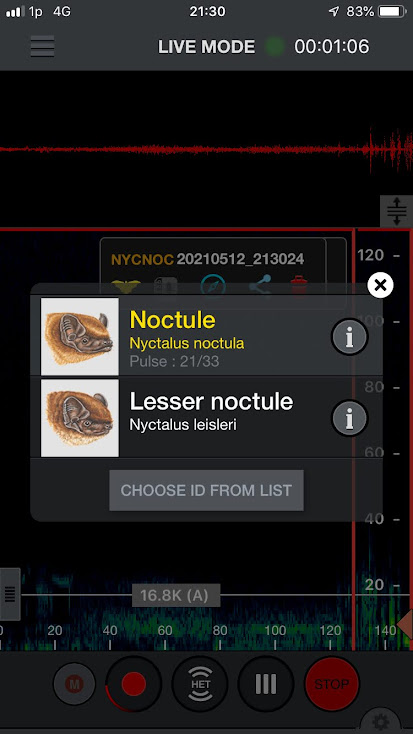
Pipistrelle & Noctule
The fields at Ovington were surveyed once in late spring and once in early autumn this year, by an enthusiastic team of Abi, Gill, Col and Mandy. The difficulty about bat surveying is that by the time they are reliably out of hibernation, the survey time (dusk) can already make for a long evening! Bat surveys could also happen at dawn of course, to see them coming back to a roost.
Bats like to live in crevices like old trees, caves and (in recent time from the bat’s point of view), house lofts. Some roosts are just maternity roosts for the summer. Bats eat insects like midges, moths – probably about 3,000 every night! Often following woodland edge or hedge lines or river banks to help their navigation.
Abi won a special bat detector this spring from Wildlife Acoustics, that plugs into a mobile phone and automatically scans all the sound waves too high for human ears for the bat calls. Gill accompanied this with a more traditional bat detector where you manually scan to the probable frequency. Gill and Col both have amazing binoculars that seem to harvest more light at dusk than there is available to the human eye!
On both surveys at Ovington we detected common pipistrelle, only a few individuals though. Or possibly the same individual three times! On the second survey we also detected noctule, together with the pipistrelle again (recording below). The records have been sent to the North East Records Centre. We did enjoy the bat survey and Mandy also got us down to Ovingham to survey the orchards on another evening.
The fields probably need some old native large trees nearby or an area of pond in order to be able to record more numbers or more species.
Bat facts: The noctule is the UK’s largest bat, it can weigh up to 40g and live 4 – 5 years but would still fit in the palm of a hand. Noctule rarely roost in buildings. Females have a single baby (pup) in June or July having mated in the autumn before, the pup is usually independent by the end of the summer. One of their favourite foods is the cockchafer. They can be mistaken for a swift in flight as they fly quite high. Bats become less and less active from October onwards and by December will be in full hibernation. As the weather warms up from March onwards they start to emerge but aren’t fully active until May.
The pipistrelle is the commonest bat in Britain and weigh only 5g (or up to 8g) or about the weight of a 20p piece. It would fit into a matchbox! They emerge from their roost about 20 minutes after sunset and fly between 2m and 10m above the ground. Summer roosts might include newer buildings such as behind tiles, eaves, between the roofing felt and tiles or in the cavity walls. Their call is between 45 Hz and 70 Hz. The call sounds like a series of clicks towards the top of the range, turning into slaps at the lower end of the range. They can fly at a speed of 7m per second. The common pipistrelle and the soprano pipistrelle were considered the same species until 1999.