Ever noticed how many different species of grass there are?
Has anybody been doing #nomowmay and #letitbloomjune?
There are thousands of different types of grass. Even bamboo (which can be 30m hight!) and sugarcane are grasses, as is wheat. Even bananas are like “cousins” of grass. A really useful food for us humans.
All grasses have long, narrow leaves. What we might think of as the seeds at the top, are actually the flowers. They are often in spikelets, perhaps in pairs or sometimes several together. The spikelets can be arranged in various ways – stalkless, long stalks – you get the idea. The small cases that protect the flower (they are called glumes) sometimes have a long, pointy projection – I call this an “eyelash” but really it is called an “awn”. Barley comes to mind when you think of these long, pointy, sometimes bristly bits.
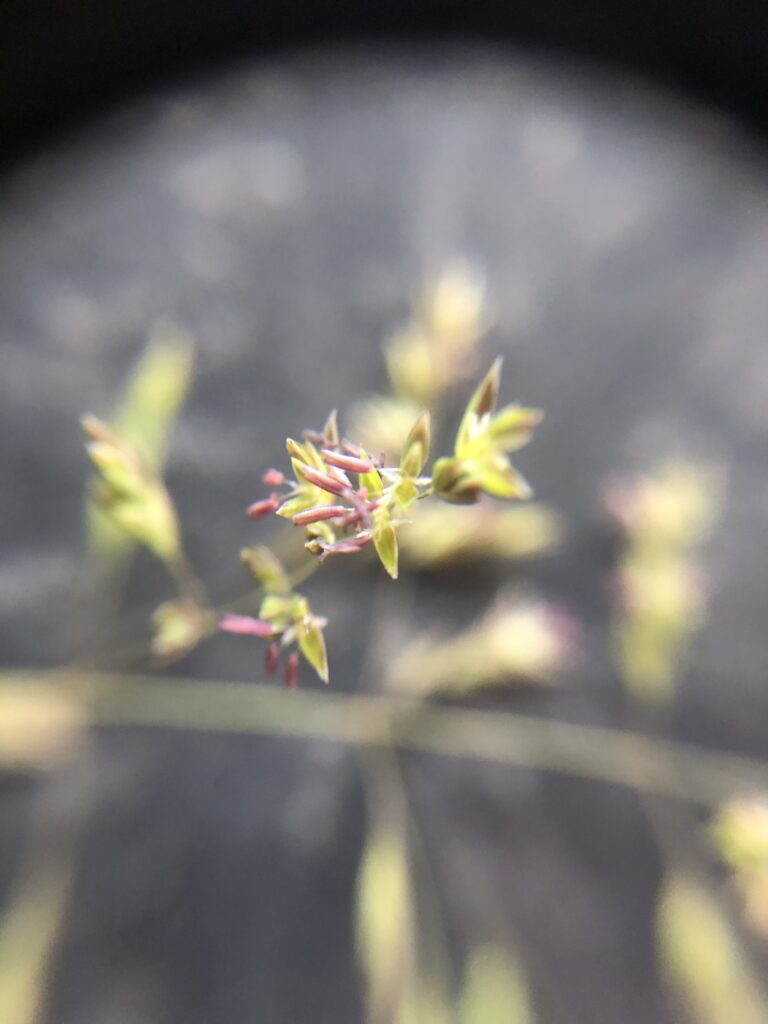
Let’s take a closer look at a common grass, it is called agrostis. The common name for this is bent grass. It is quite a delicate grass.

It is possible to see, with a hand lens, the female and the male parts of the agrostis flower. The female parts have a style with 2 or 3 stigmas: these are feathery bits wafting around trying to catch pollen. The male parts have 3 stamens coming out, pink / purpley coloured. Amazing! The anthers are on little flexible filaments, which helps them distribute their pollen, even in gentle wind currents.
About 3.5 million years ago, our human ancestors changed their diet from eating fruits to also eating grasses. It is thought that this change is an important factor in our evolution, allowing us to grow bigger brains for example. The grasses started to be cooked, which means the starches can be digested by us better.

Look carefully in some of these 4 photos and you will also see almost translucent the feathery stigmas. They look a bit like an old-style TV antennae. (Or perhaps old TV antennae were designed to be as efficient as nature – capturing radio signals instead of pollen). As you can now imagine, grasses are wind pollinated. One reason why some people suffer with hay fever! They are so well adapted to being wind pollinated, they don’t need “flowers” with petals. The feathery stigmas are sticky and allow pollen to be caught.
Grasses are not just crucial for humans’ diets, but also for animals. In the UK, there are about 200 species. Grass stems are hollow (except for maize).
As well as humble agriculture – from subsistence farmers all over the world, to large arable farms with massive machinery – grass is also part of the sports world. Golf courses, sports pitches and tennis (soon Wimbledon days are upon us!) rely on grass. Also, where would we be without beer! Many alcoholic drinks are founded on grass, corn, wheat, or rice. Or paper! Some grasses have been used over time to make paper, like papyrus in ancient Egypt. Grasses are also the food plants for some caterpillars and so are useful in the ecosystem and food web beyond us humans.
Other common grasses you might come across are Timothy, Yorkshire Fog, Poa, Meadow grass, Crested Dog’s Tail, Brome, Cock’s Foot, Oat grass, Rye grass, Fescue, Tufted hair grass, Marram grass (day out at the seaside?) and Purple Moor Grass.