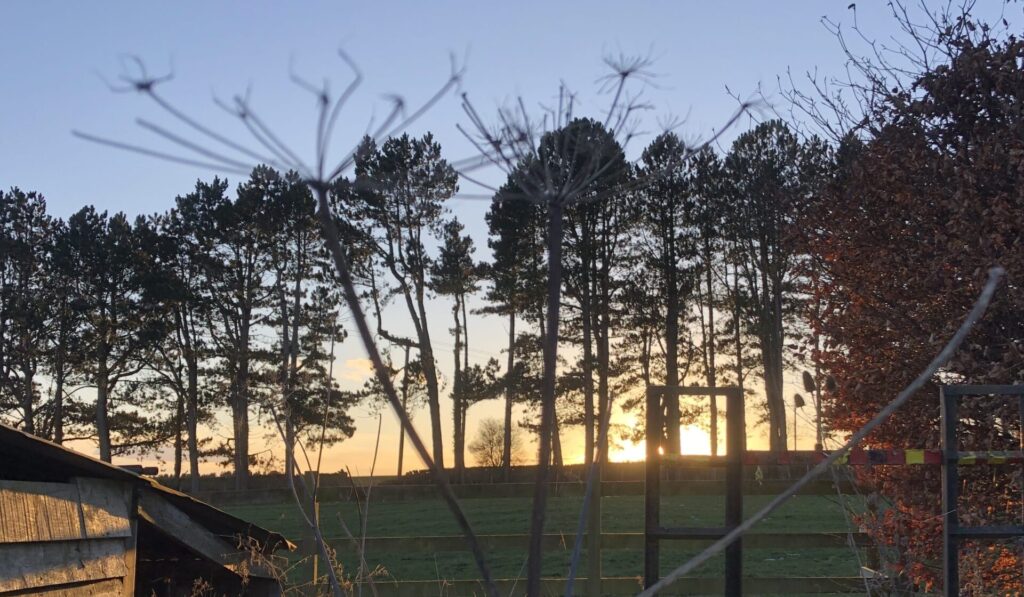
Like many growers, 2023 is a year I’m glad to see the back of. Early spring was ok, normal-ish, then turned into a dry May and a blazing June. This meant that we had lots of young plants that needed careful monitoring and constant attention, the ambient temperature seed sowing had to be done in the propagator shed to prevent seeds from cooking – and then it rained… and rained…. and you guessed it … rained!
Even now in late December two consecutive dry days are as rare as hens teeth! The plants we did get growing were suddenly attacked by all manner of pests; pigeons, rabbits, moles, spider mites, aphids, and slugs; lots of slugs (check the website for descriptions of all manner of pests https://golocalfood.org.uk/news/)! No! Enough! Goodbye 2023!
A whole new growing season. Endings and beginnings are of course a little artificial as there is never a time when the fields are truly empty and the work is never actually done. However growing slows down with reduced light and temperature change, providing an opportunity for all those little repair jobs that lack attention come spring. It’s also the time of year when we try to complete our latest ‘project’. This year we started creating a set of raised cold frames using shelf racking, in an attempt to reduce slug and rabbit damage to new plants. Sometimes we forget that farming isn’t just about the plants, it involves a diversity of tasks, requiring a whole range of skills – which makes the role more interesting or challenging!
Growers everywhere consider January to be the start of the growing season (as opposed to autumn being the start of the shepherding year or April the start of the financial year). For us it’s a time for optimism again, our mindset is positive. We learned so much from last year and this next year is going to be so much better! We know THIS crop worked, and if we tweak THAT crop it’ll be better THOSE grew well but if we try THESE they will taste so much better. So January is the time to sit in front of the fire sifting through the catalogues whilst dreaming of the harvests to come – and these feelings last for about a fortnight!
Sifting through the catalogues choosing what to grow is the first part of planning. So how do I choose what to grow?
First of all I’m guided by our members who are surveyed every year to see which crops were favourites and which were less well liked. Last year a new crop was trialled, souping celery, which was ‘unpopular’ so we have dropped it from the growing list this year. However, talking to some members they missed it in late autumn when making broths so I may grow a small bed as an option next year. It’s interesting that unpopular can often mean ‘I don’t know what to do with it’ – one of the challenges for growers and members (consumers) alike.
I also keep a watchful eye on the swap box where sometimes all that’s left is a certain crop which points to it being unpopular; this year Flat kale springs to mind so I will try a different variety next year.
Using these as a guide I try to provide the 4 basics; Summer shares will have potatoes, an allium a salad crop and a brassica. The winter basics will be potatoes, an allium, brassicas and roots.
Working around these I fill the shares with flavours. Summer is easy, radish tomatoes cucumbers and legumes then squashes and peppers in late season. Winter fillers are harder but carrots parsnips swede and spring greens can feature at this time
Finally every now and then I’ll try and throw something unusual in, we tried souping celery last year but we’ve also experimented with Yacon, sweet potatoes, and Kialaan Kichi which was a bit of a mouthful to say as well as eat! Some experiments are now a staple, Uchiki Kuri has become an annual treat.
These things provide the framework, perusing the seed lists and plant descriptions guide us to making a choice. The descriptions of each variety is an advertisers dream. Reading the subtext becomes an art. Being a pessimist definitely helps!
While we need our crops to produce plenty for harvest a description like ‘heavy cropper’ might mean it has lots of small tasteless fruit and I have found those described as having ‘superb flavour’ tend to produce fewer fruits. One day I’ll find a catalogue where all the crops are described as being “abundant large fruits with great flavour, quick growing with resistance to bolting and stores well after harvest” – another dream.
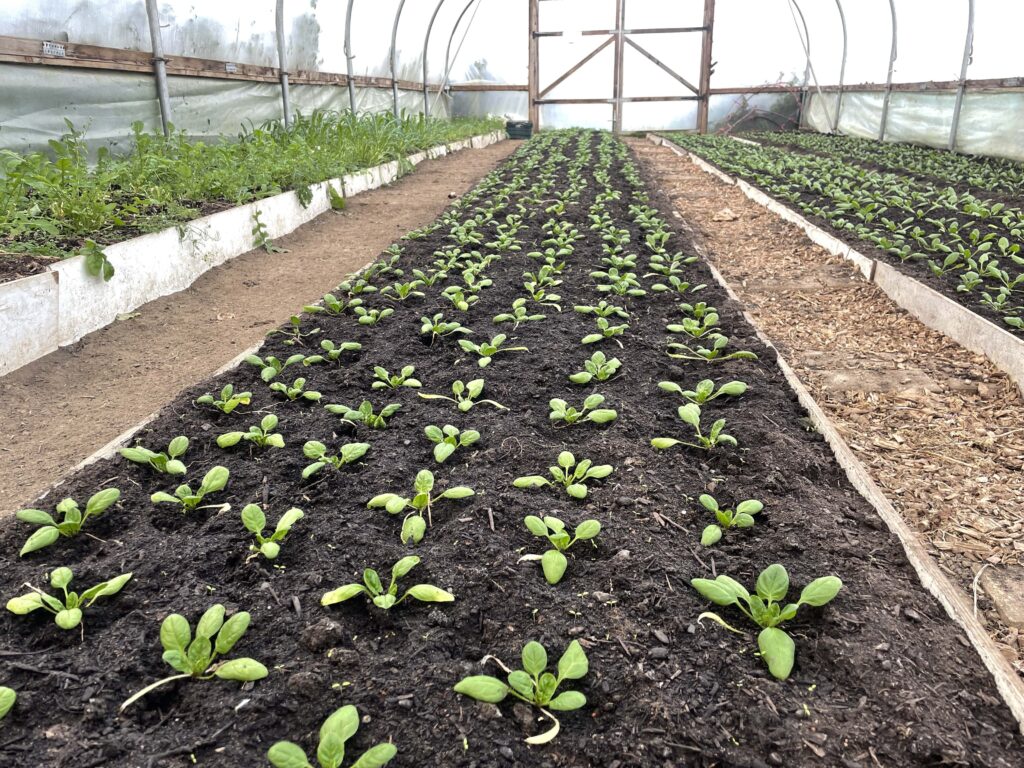
And soon – oh so soon – the new growing season will be upon us. By mid January we’ll be planting seeds; spinach, chard, onions. Next year we are spreading our bets with the onions by adopting three different types of planting; onion sets directly into the ground outside, sets in cells planted in the tunnels, and seeds sown into cells to be planted on when large enough… And off we go again.
Whatever 2024 brings – it will be – different!