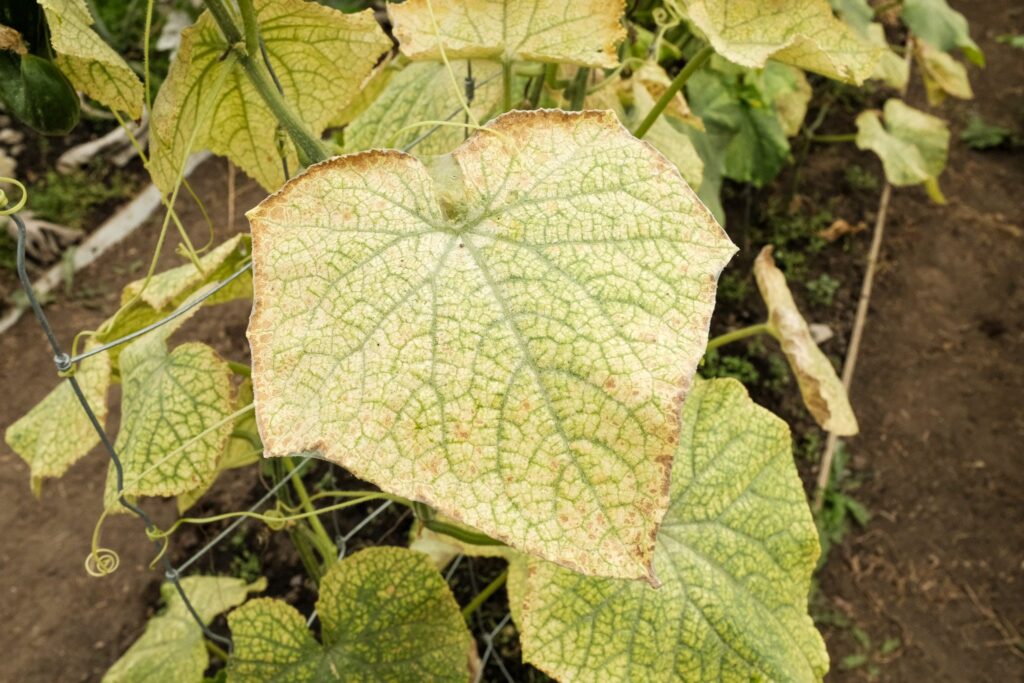

Ian has noticed these leaves looking rather yellow. This is a cucumber plant that is being affected by the red spider mite. He said, how they were so tiny and yet taking all the goodness from the plant. They pierce the leaves with their mouths and then suck out the plant juices. Despite their name, the red spider mite aren’t always red! Sometimes yellowish-green with two dark patches, or reddish-orange in autumn. In a heavy attack on a plant, a fine silk webbing might be seen. The mites are about 1mm long, so glasses out! Normally you would find them on the underside of the leaves, along with their spherical eggs. In the right conditions, a spider mite population can grow very quickly – at 25C the eggs develop in only 10 days. It is a spider (so not an insect).

Ian also spotted this white-tailed bumblebee and was excited to see one. As a pollinator, the grower’s friend! A white-tailed bumblebee colony is about 200 “sisters”. The nest is often underground in an old rodent burrow. The males develop in August and hope to mate with a potential queen for next year. She is then the only one who overwinters. The white-tailed bumblebee is actually three species grouped together: the ‘true’ white-tailed, the northern and the cryptic bumblebee. At the moment, they can only be separated by DNA. This bumblebee has a short tongue which means it prefers more open flowers. They can get nectar from deeper flowers by biting a hole from the outside near the base of the flower. This is called “nectar robbing” as the flower doesn’t get pollinated! We think it will be happy on flowers like courgette.
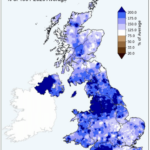
Carrying on with our theme of matching wildlife we see on the fields with the weather, let’s look at a few maps from the Met Office. The met office produce climate summaries here www.metoffice.gov.uk/research/climate/maps-and-data/summaries/index. July, across the UK, was the 6th wettest July on record. The summer as a whole was skewed by June so it is better to just look at July and August reports. This map shows how wet it was compared to the average between 1991 and 2020. I think we can all see the dark blue area just west of Newcastle, showing that we were about 200% wetter than the 1991-2020 average. It definitely felt very wet! Some other parts of Northumberland, in the Tweed valley, appeared to have a more normal July, but not here!
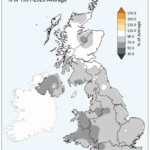
In tandem with such a wet July, of course, the sunshine duration is down. This map shows the same month, July, and compares the sunshine duration with the 1991-2020 average. This area had between 70% and 90% of the average. 100% would have been in line with “normal”. It felt like we were nearer the 70% than the 90%, didn’t it! If you are the type of plant or insect that likes wet and cool, or at least not direct sunlight and drying out – then you were having a good month. If you were the type of plant or insect however that needs dry and sunny and warm – a plant likes that to grow, or an insect needs that for its young ones or for its food supply – then you were having a bad month. Having said that maybe we “mustn’t grumble” as any growers in the midlands are seemed to have the wet July and even less sunlight duration – about 50% of their average. It looks like somewhere like Darlington was average in terms of sunlight. Nowhere in the UK seems to have more than average.
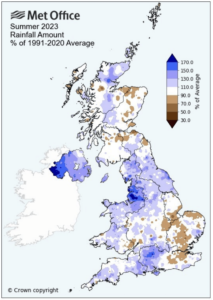
Finally then, let’s look at the summer as a whole. Which, for the Met Office, means June, July and August. In our case the first week of September should have counted as well as it was a lovely week! And back on the topic of rainfall. Even accounting then for the very dry June, we can still see the Go Local area – perhaps it is even that dark blue dot in the Tyne Valley. About 150% or even 170% rainfall in the summer overall compared to the 1991-2020 average. Phew! Again, bits of Northumberland around Berwick had less rain overall along with the south (but we’re fed up of hearing about the south of England on the weather forecasts, aren’t we!) What will autumn bring us? You can always find the long range forecast here www.metoffice.gov.uk/weather/long-range-forecast. More unsettled generally seems to be the watch-word, although the first fortnight of October might be OK, although the Met Office hedge their bets a bit with such a long-range outlook. As autumn comes we will have the cooler nights and the photogenic misty mornings and of course we have all noticed the nights drawing in now.